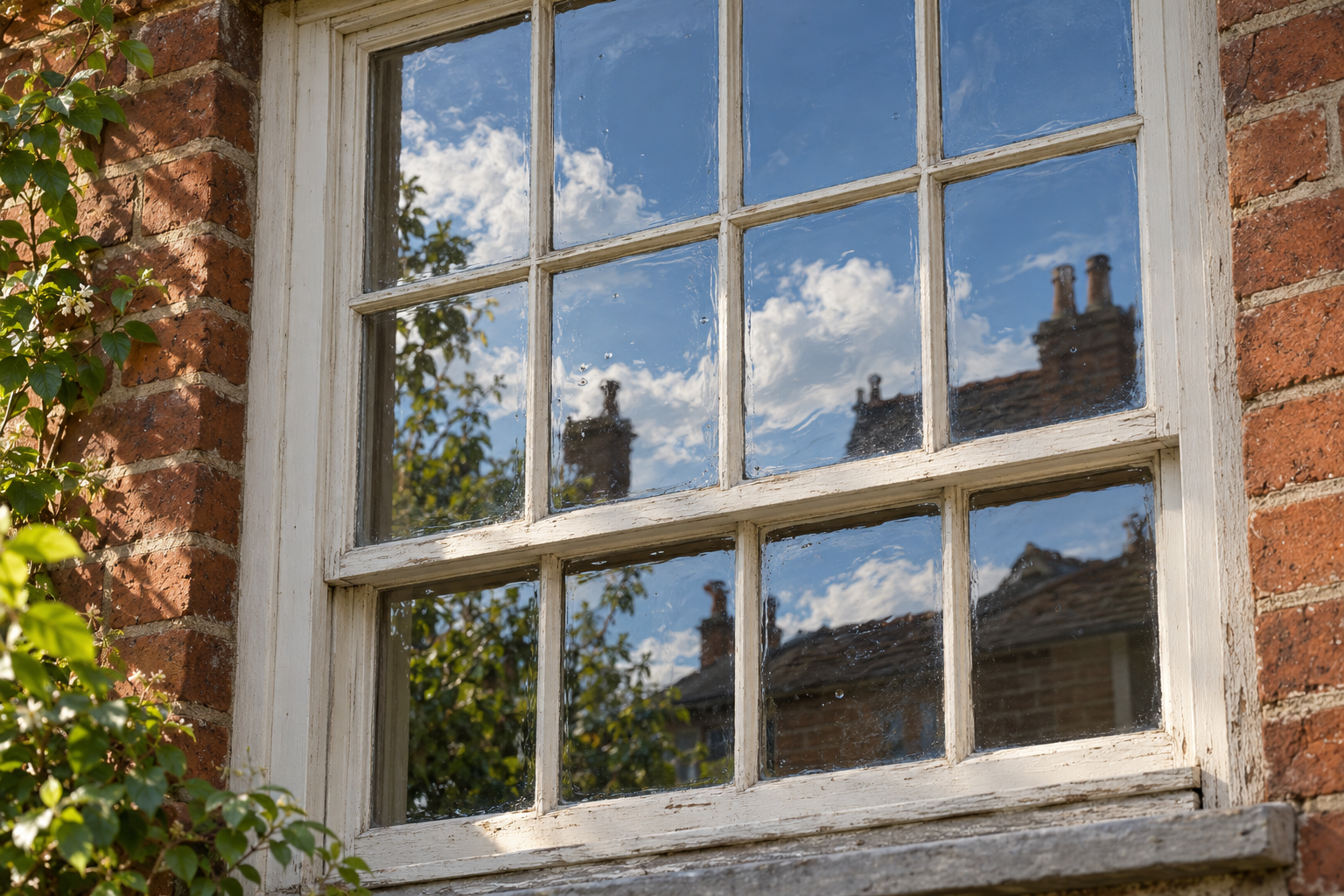
Walk past an old sash window and the reflected sky may break into narrow, wavering strips. A roofline that looks straight in the brickwork bends across one pane, recovers itself at the glazing bar, then bends differently in the next. From inside, a branch beyond the window can kink where it passes behind the pane's waviness. The glass has become visible because it redirects neighbouring rays differently.
That small spectacle has a material history. Many older panes were shaped by breath, rotation, heat and the patient work of opening a sheet. Their surfaces and thicknesses did not end up perfectly uniform. The variations alter a reflection, a view through the window and the colour of transmitted daylight in different ways. Calling all of these effects a “sparkle” loses the most interesting part of the story.
A surface that changes direction
Light meets two surfaces when it crosses a pane: the outside face and the inside face. Some reflects at a surface; some enters the glass, bends, and bends again as it leaves. If a face has a shallow wave, its local slope changes along the pane. A line reflected from that surface can therefore kink or roll, while the view through it may be displaced in another way. The window is usually clear enough to show the world beyond, yet its small departures from flatness keep announcing themselves when the light or the observer moves.
This is an optical effect, not evidence that old glass somehow gathers more light. In experimental work on textured glass, researchers at the University of Washington describe how a relatively smooth but wavy surface refracts viewing rays into a distorted image; finer texture can blur an image more strongly. Their samples were modern privacy glass, not historic sash panes. The useful lesson is the path of the ray. The degree of distortion in any old pane depends on its own surfaces, the background and the viewing angle.
The Tewkesbury Borough Council historic window guide makes a close observation about later cylinder-sheet glass: even after makers had reduced its ripples, reflections viewed obliquely could still run unevenly across the surface. This explains why a pane can look almost plain when faced squarely and become lively from the pavement. The reflected roof or cloud gives the eye a line against which to see the surface change.
The shape left by making
One route to a window began with a blown bubble. In the crown process, a glassmaker opened and spun it into a disk, then cut panes from the cooled sheet. The centre, where the rod had been attached, was thicker. Panes cut elsewhere could retain slight ripples. The Tewkesbury guide describes both that thicker bull's-eye and the finer, clearer sheet that crown glass offered compared with earlier glass made by other methods. A bull's-eye is an identifiable part of a disk; a mild wave elsewhere is a quieter record of the same forming process.
Another route began with a cylinder. The glassblower stretched a bubble into a long form, removed its ends, slit it lengthwise and reheated it until it opened into a sheet. A Corning Museum of Glass account of cylinder making notes that the workman smoothed the opened glass with a wooden block, leaving blemishes and irregularities in the finished sheet. These were practical methods for producing usable glazing, and they changed over time. A surviving pane need not advertise its method loudly: even within one window, its neighbours may show different degrees or directions of waviness.
By the twentieth century, industrial processes could make a more even sheet. Pilkington's 1957 patent for flat-glass manufacture describes carrying a continuous ribbon over a thermally controlled bath of molten metal, particularly tin. The process was announced in 1959; a 2024 profile from Pilkington's parent company, Nippon Sheet Glass, shows the glass spreading and levelling on molten tin. It gave builders a way to obtain broad, consistently flat panes without the same visible traces of hand forming. A flat reflection is a useful achievement, especially where an undistorted view matters. The old pane's appeal comes from a different result of making, not from a failure to discover better glass.
What passes through the pane
Surface shape is only part of the light story. Glass can also absorb some colours more readily than others. Iron in the raw ingredients can lend an otherwise clear pane a greenish cast; thickness affects how much light travels through that material. A thick pane of relatively pure glass is not automatically brighter than a thinner pane with more colouring impurities.
A 2021 study of excavated window fragments from Middelburg-in-Flanders makes that distinction unusually concrete. The researchers measured spectra from 29 pieces of plain glazing and compared an earlier group of crown-made, lozenge-shaped fragments with later, quadrangular cylinder-made fragments. The later glass was greener and contained more light-absorbing impurities, yet its smaller thickness gave it greater calculated daylight transmission in the authors' comparison. The result concerns those fragments and simulated spectra at specified thicknesses; it does not tell us exactly how bright a particular room once was. It does show why colour, purity and thickness must be considered together.
The researchers also cleaned small measurement areas on weathered fragments before recording their spectra. That step matters when looking at a pane today. A tint inherited from the melt, an uneven surface left by forming, and changes acquired during use or burial are different histories. They can meet in one piece of glass, but one should not be used as a shortcut to explain the others.
There is a tempting shortcut about thickness, too. Old windows are sometimes said to be thicker near the bottom because glass has slowly flowed downward. A 2017 original study of a representative medieval cathedral-glass composition calculated that its room-temperature flow would be imperceptible on any human timescale, even allowing for differences in the glass's thermal history. Uneven thickness belongs principally to making and selection, not centuries of visible sagging. The study concerns that composition and a model of its behaviour; it is enough to rule out everyday flow as the explanation for a pane's waviness.
Keeping the evidence in place
An old pane is easiest to appreciate when it remains in the window for which it was cut. Its reflection is divided by the bars around it; its thinness belongs to the scale of the sash. Historic England notes that surviving historic glazing is rare and valued, and that thinner glass allowed slender glazing bars. The US National Park Service's window preservation brief treats the glass as part of a window's historic material and describes reusing sound panes during repair. Neither source suggests that every ripple proves an original date, or that a cracked pane should remain merely for romance. Material, frame and building need to be read together.
The light in an old window has no secret source. It is the same sky and street offered to every pane. What changes is the route: one shallow curve catches a roofline, another nudges a branch, and a trace of colour alters what reaches the room. The glass holds the marks of how a sheet was made, so the act of looking can reveal the making still there.
A thought worth keeping?