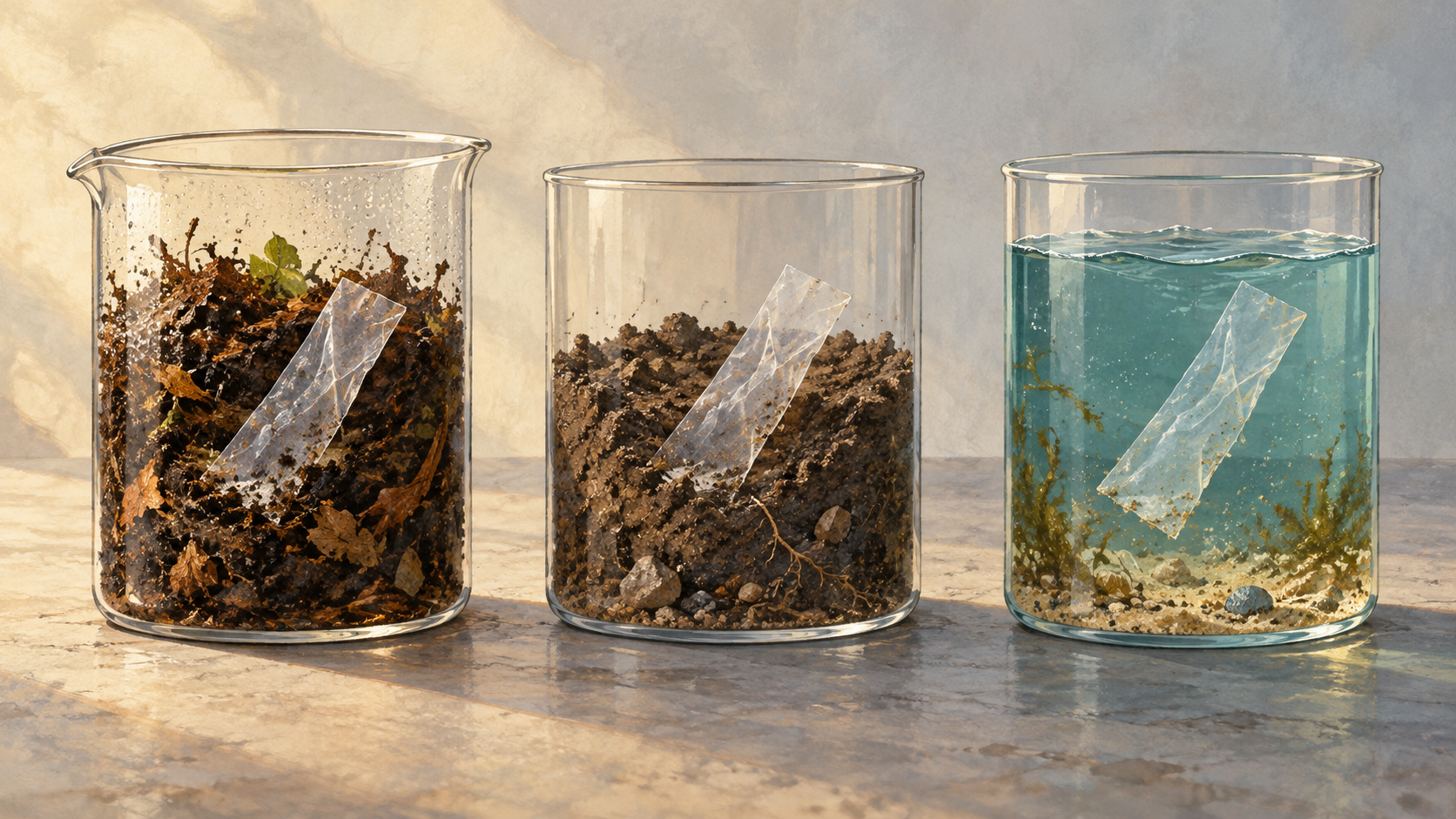
A plastic bag can become too weak to carry groceries while much of its material is still there. It may split along a seam, fray into pieces, or disappear from the frame in which researchers left it. Each change matters. None, by itself, tells us that microbes have used the plastic's carbon and returned it to the surrounding cycle. That is the trouble with calling a plastic biodegradable without saying where, how, and over what time.
The word sounds like a property held inside the object, as fixed as its colour or thickness. Biodegradation is an encounter between a material and a living environment. Water, oxygen, temperature, sunlight, the shape of the item and the organisms present all change the outcome. The European Commission's policy framework makes a useful preliminary distinction: biobased describes the source of a plastic's raw material; biodegradable describes a possible end-of-life process. A plastic made from plants need not biodegrade, and one that can biodegrade need not be made from plants. Neither word supplies a disposal address.
Following the carbon, not the outline
At the first visible stage, a film may become brittle or break into smaller pieces. A laboratory can measure that loss of form as disintegration. To establish biological breakdown, it needs evidence that organisms have acted on the material itself. Under oxygen-rich conditions, a strong test follows the plastic's carbon into carbon dioxide, with some carbon also entering microbial biomass. A container that vanishes from sight is therefore an incomplete measurement: it may have mineralized, dispersed as fragments, or done some of each.
The distinction is built into ISO 14855-1, a method for testing plastics under controlled composting conditions. It measures evolved carbon dioxide to estimate how much of the test material's carbon has been converted, and it also checks disintegration at the end. The compost inoculum, temperature, air supply and moisture are controlled. The standard answers a precise experimental question about an aerobic composting environment; it does not measure what an identical item will do beside a road or on a cold seafloor.
Researchers can go further when a material degrades very slowly. In a freshwater experiment with carbon-13-labelled polyethylene microplastics, Sami Taipale and colleagues traced carbon from the plastic into gas and microbial lipids. They detected genuine microbial use, but only a small fraction was transformed during their eight-week incubations, and the rate differed among humic lake water, clear lake water and an artificial medium. Even a material normally called persistent can show a measurable biological process when the method is sensitive enough. That observation does not turn an ordinary polyethylene bag into a timely biodegradable product. Rate and setting belong in the claim.
The same plastic meets different worlds
There are separate test methods because compost is not soil, and soil is not seawater. ISO 17556 measures the ultimate aerobic biodegradability of plastics in soil through oxygen demand or carbon dioxide production. Its method adjusts soil humidity to obtain a favourable test and distinguishes soil not previously exposed to the material from soil deliberately pre-exposed to it. Passing a controlled soil test would be meaningful evidence about that test's conditions. It would not establish a decay time in every dry field, waterlogged verge or riverbed.
Compostable narrows the destination further. The Commission describes compostable plastics as a subset designed for controlled treatment, usually in an industrial facility; it also notes that home compost conditions differ greatly and that the material first has to be collected. A fork labelled for industrial composting has a route in mind: an organics collection that accepts it, followed by a plant whose process can handle it. A back-garden heap, a landfill and a lake cannot be assumed to supply the same heat, air, moisture and microbial community. The mark on the fork cannot arrange its journey to the right place.
A three-year study of carrier bags makes the variation hard to ignore. Imogen Napper and Richard Thompson compared one compostable bag, one sold as biodegradable, two sold as oxo-biodegradable, and a conventional polyethylene bag in open air, buried soil and seawater, as well as laboratory conditions. The compostable bag disappeared from its seawater test frame within three months, but the same type remained present in soil after 27 months, although it could no longer hold a load. After nine months outdoors, all of the tested materials had broken into fragments. Those results do not make the compostable bag generally marine biodegradable: the study recorded deterioration and loss of visible material, not a full carbon balance proving mineralization in seawater. Nor do they show that every product with the same label will behave exactly like the particular bags tested. They show why environment and the measurement chosen cannot be omitted.
Oxo-degradable deserves its own caution. The label refers to additives intended to promote oxidation and breakup of plastic. Napper and Thompson's oxo-labelled bags were still functional after extended exposure in soil and sea. The Commission's framework also notes that oxo-degradable plastics do not biodegrade completely and can interfere with conventional plastic recycling. A smaller fragment is not a completed biological return; it may be harder to collect and still persist. The question is not whether a bag can be made to crack, but where its polymer carbon goes after the crack.
The sea gives a second, more constructive finding. In field experiments at shore and deep-sea sites, Taku Omura and colleagues exposed different plastic formulations and examined weight, thickness, surfaces and associated microbes. Several polyhydroxyalkanoates and other tested polyesters lost material, though more slowly at deeper sites. The poly(l-lactic acid) tested did not show measurable loss at either the shore or the deep-sea sites during the study. The result shows real differences among polymers that can all be discussed under the broad heading of biodegradable plastics. It does not mean the ocean is a suitable disposal system for the ones that changed: the observed rates depended on the material and site, and field weight loss alone is not a guarantee of full biological conversion without residue.
A facility is another set of conditions
Even a destination built to compost organic waste is not identical to a laboratory vessel. Zhi Kai Chong and colleagues tested two prototype packaging blends in controlled compost experiments and in an operating industrial plant. Their rigid, PLA-based sample retained about 69% of its mass after three weeks in the comparison laboratory test, against about 98% after three weeks at the plant. Their thinner, PBS-based film showed a different pattern: similar remaining mass in the two settings at that point, with more fragmentation in the lab. The work measured disintegration of two prototypes, not ultimate mineralization or the performance of every certified compostable product. It shows that a plant's residence time and mix of organic waste can change what a test result means in practice.
For a person holding a package, the useful questions are plain. Which material was tested, in what environment, by which method, and for how long? Does the evidence follow the carbon or merely the disappearance of pieces? Is there a local collection route, and does its receiving facility accept this item? A credible label can answer those questions or point to a verifiable standard and disposal instruction. “Biodegradable” on its own asks the reader to supply missing conditions, often without knowing that they are missing.
Careful wording does not make material science trivial. Some polymers demonstrably change in difficult environments; others persist where a marketing category might suggest otherwise. Composting can be a practical route for a product that reaches an accepting facility and breaks down within its process. The necessary precision is modest: name the destination, the time, and what was actually measured. Then the word describes a tested possibility rather than a promise that the object will take care of itself wherever it lands.
A thought worth keeping?