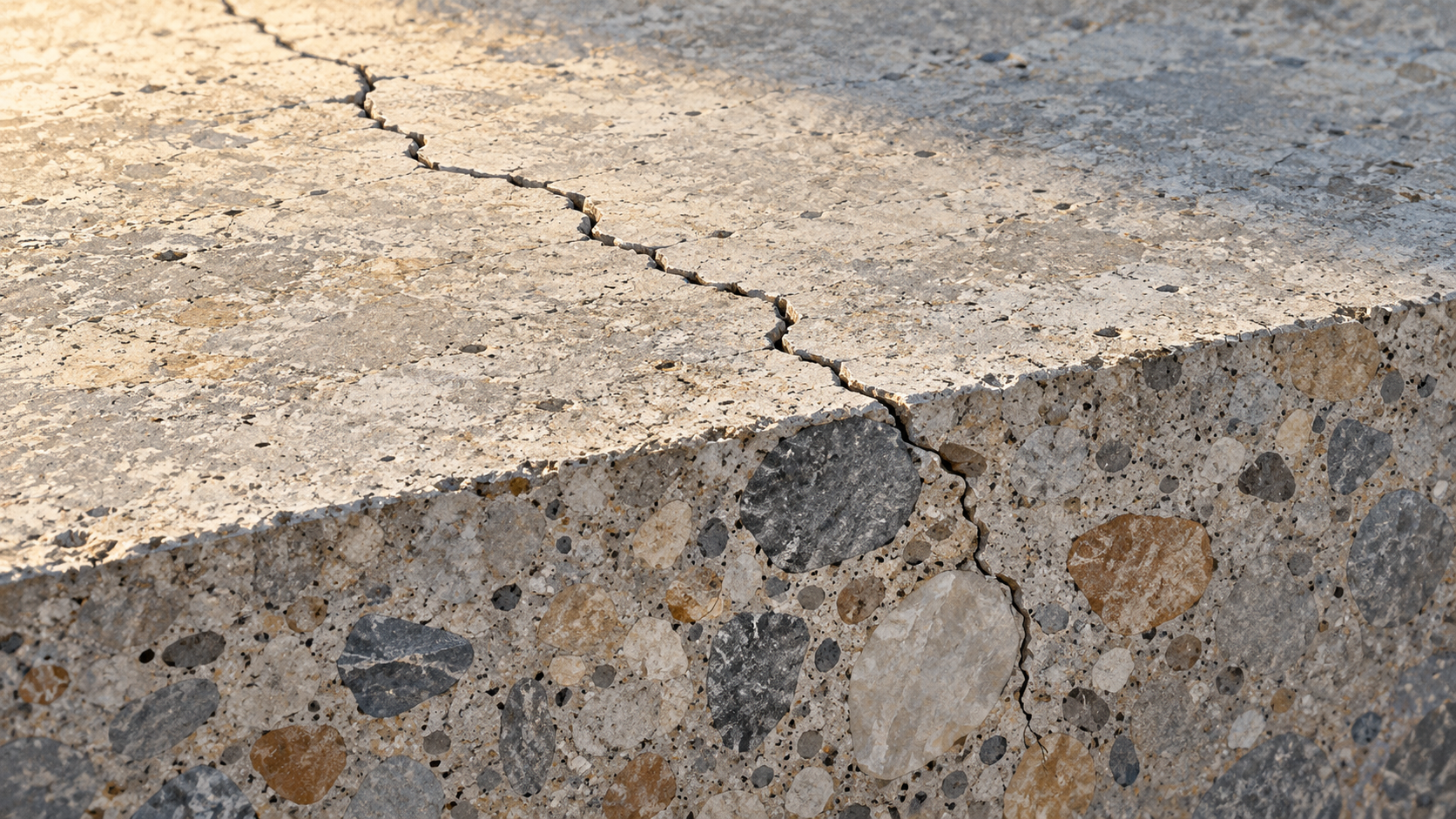
A crack in concrete can look like a single mark made in a single moment. The material tells a slower story. Concrete is a mixture of hardened cement paste, sand and larger stone, with countless boundaries between them. A line visible on the surface may be the joining of smaller fractures that began inside, or a surface split that has deepened with time. In experiments reported by the National Institute of Standards and Technology, researchers followed cracking in aggregate and in the surrounding paste with acoustic measurements and X-ray imaging. The distinction matters: a crack does not travel through a uniform block. It meets different materials and different resistance at almost every turn.
First, something tries to pull the concrete apart
Concrete carries compression well, but its resistance to tension is much lower. Tension need not arrive as an obvious pulling force. A slab drying after it hardens contracts. If the base, adjoining concrete, or embedded steel prevents free movement, contraction produces tensile stress. The American Concrete Institute’s guide to cracking explains that the drying surface can contract before the interior does, setting the outer layer in tension even without an external restraint. The stress may partly relax with time; a crack opens when what remains exceeds the concrete’s local tensile resistance.
Temperature can produce a similar conflict. New concrete warms as cement hydrates, then cools and contracts. Sun and air can change the temperature of an exposed face faster than the interior. A Federal Highway Administration report on pavement curing describes cracking when this movement is restrained by a road base or by concrete at another temperature. Traffic, a loaded beam, uneven support or settlement can also place some region in tension. The visible crack is therefore a response to a stress history, not a diagnosis of its source. The FHWA petrographic manual catalogs several possible causes, from early drying and thermal movement to corrosion and applied loads.
The timing changes the story as well. Fresh concrete can lose moisture rapidly from its exposed surface before it has hardened; its weak, still-plastic skin may split. Hardened concrete can crack later as drying continues under restraint. Calling both “shrinkage cracks” hides the difference between deformation before and after a solid bond has formed. The FHWA manual makes that distinction because the fracture surfaces and likely remedies can differ. A fine line that appeared within hours of placement is different evidence from one first noticed after years in service, even if their outlines happen to resemble each other.
Then a path finds its way through stone and paste
At a small scale, local stress concentrates near a flaw or a developing crack. Tiny separations can grow and join until a connected line is visible. A crack may follow the boundary between an aggregate particle and cement paste, detour around a harder stone, or cross the particle itself. The NIST-led wedge-splitting experiment deliberately fractured paste, stone and their interface to distinguish the signals from each constituent. In its separate tests on reactive aggregate, cracks began within the tested stone and later extended into the matrix. That is an observation about those mixtures and conditions, not a rule that all concrete cracks begin in aggregate.
This uneven route explains why a line can wander rather than cut a straight geometric path. It also prevents a tempting shortcut in diagnosis. Seeing a crack skirt stones does not prove that it formed while the concrete was fresh. The FHWA petrographic manual warns that an aggregate-paste bond can be weak for several reasons, including conditions that arise later in the material’s life. A single broken stone, too, may reflect a weakness in that particle rather than the age of the whole crack. The path records where separation was easiest under the stresses present; it does not write a date on the surface.
Once a fracture opens, the remaining concrete must carry forces around it. Whether the line lengthens depends on the changing load, the restraint, the material ahead and the resistance left across the crack. In reinforced concrete, steel can transfer tension across a cracked region and help limit the opening; it does not make cracking impossible. The ACI guide treats reinforcement and contraction joints as ways to control the location and distribution of cracking. A saw cut in a pavement is an intended weak line where movement can be accommodated more predictably. The FHWA curing report describes the difficult timing: cut too early and the edge can be damaged; cut too late and cooling may already have produced an uncontrolled crack.
Some cracks begin from within
Weather matters after the concrete has set, particularly when water and salts can reach embedded steel. Normally concrete’s alkaline environment helps protect reinforcing steel. Chlorides or carbonation can compromise that protection in some exposures. If corrosion develops, rust occupies more volume than the steel from which it formed, pressing on the surrounding concrete. The resulting crack may run along the level of the reinforcement and eventually accompany delamination or spalling. The ACI corrosion guide describes this expansive mechanism. The FHWA petrographic manual notes that an existing surface crack can also shorten the protective path between an exposed face and the bar. Cause and consequence can thus reinforce each other without every wet crack being a corrosion crack.
This is why the size of a line in a photograph is poor evidence on its own. A shallow, stable surface crack and a crack that crosses a loaded member, admits water or widens between inspections ask different questions. For bridge elements, FHWA’s original field protocol records location, orientation, length, width, possible depth, moisture, staining and exposed reinforcement, then compares observations over time. It does not ask an inspector to infer the whole history from one width. Pattern and movement, together with the member’s role and exposure, give the line meaning.
A crack travels when local stress and deformation outrun the material’s capacity to hold together. That sentence is simple; the evidence needed to apply it is not. It asks what moved, what held it back, what the fracture met on its way, and whether the force is still acting. Concrete keeps those answers imperfectly, in its aggregate, its edges, its stains and the change between one inspection and the next.
A thought worth keeping?