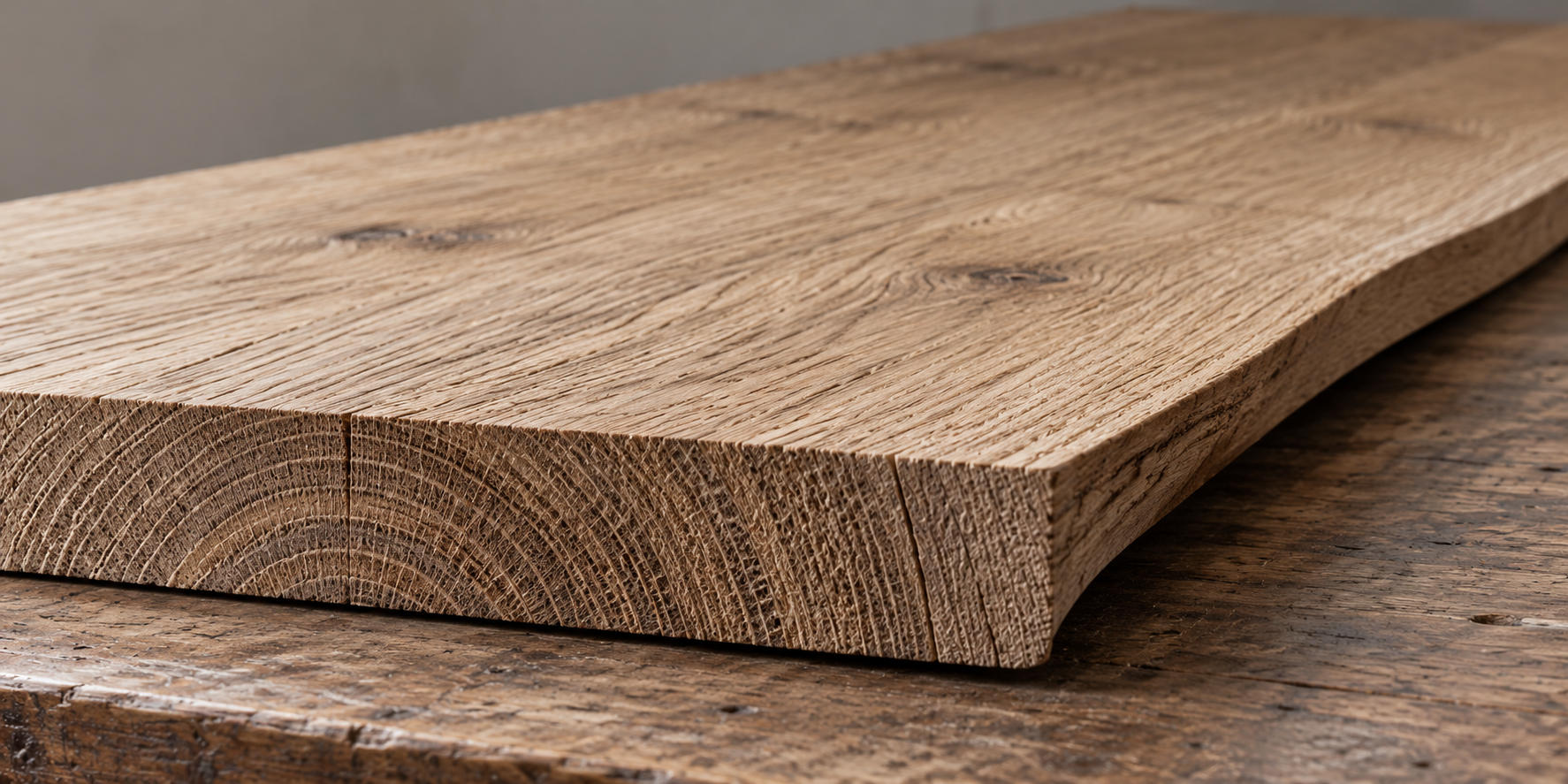
A board can leave the workshop flat and arrive at its destination with a faint hollow across its face. Later, a fitted drawer may begin to rub, or a line may open between floorboards. These are small changes, easily blamed on a careless cut. They can also be a record of water moving through wood that looks and feels dry.
The useful question is not whether the board contains water. Unless it has been dried in an oven for measurement, it almost certainly does. The question is where that water is, how the surrounding air is changing, and whether both faces of the board have had time to respond. Those three details explain why a board may change width quietly, bend for a while, or split under a harsher change.
What “dry” measures
Wood scientists measure moisture content against the mass of the wood after oven drying. If a specimen has a kilogram of oven-dry wood and holds 100 grams of water, its moisture content is 10 percent; the finished specimen weighs 1.1 kilograms. This convention explains an otherwise startling figure in the US Forest Products Laboratory's account of wood moisture: freshly sawn wood can have a moisture content above 100 percent. The water is being compared with the dry wood, not with the total wet weight.
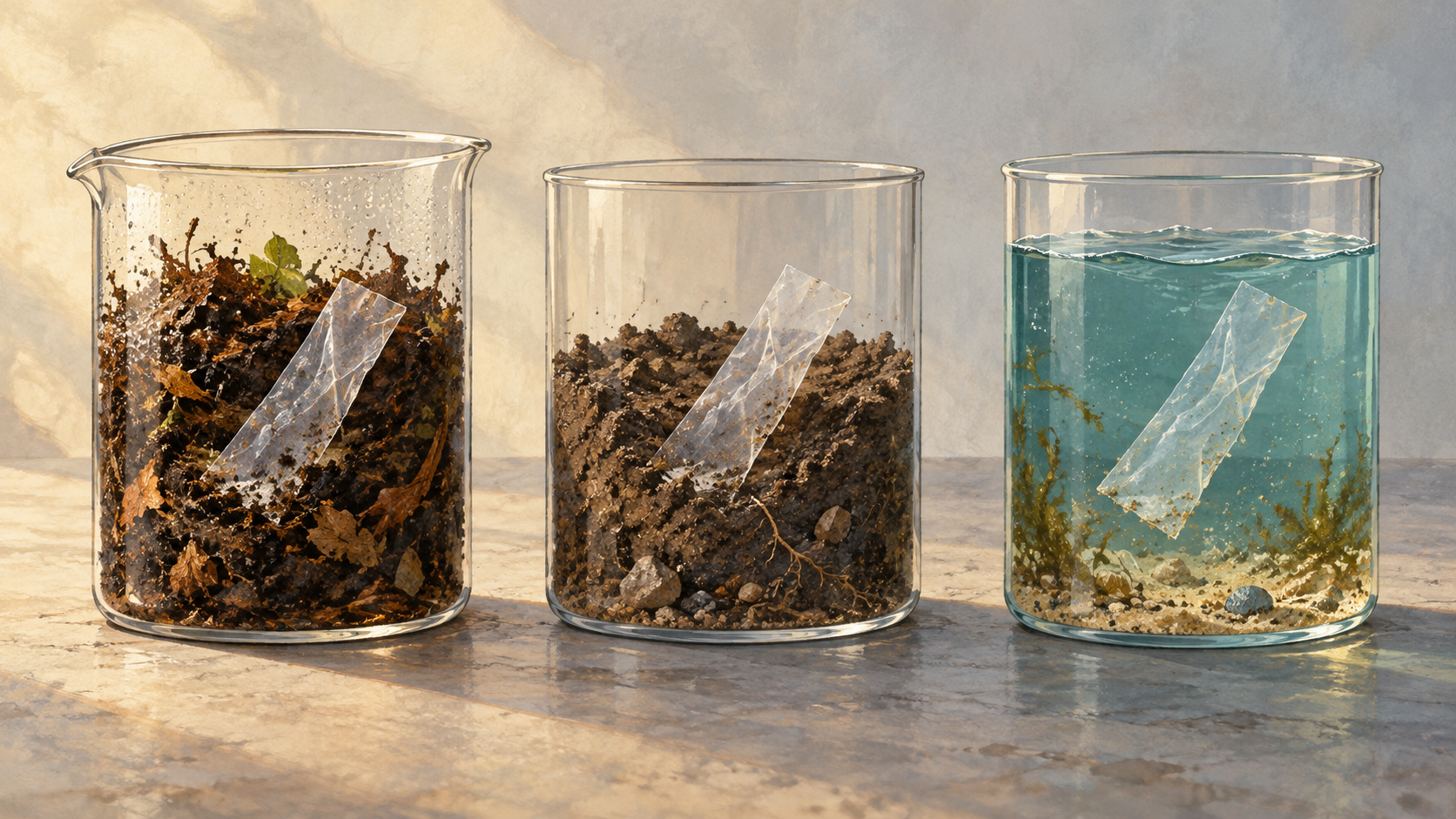
That water has more than one home. A tree's wood contains long cells with internal spaces, or lumina. Water can occupy those spaces and the smaller cavities between them. It can also enter the cell walls themselves, where it interacts with the wall's polymers. The familiar terms free water in the cavities and bound water in the walls are useful for telling these locations apart. A board intended for an indoor room has shed much of the water it held as green lumber, yet its cell walls still exchange water with the air. The moisture that remains is part of ordinary dry wood, not necessarily evidence of a leak.
The categories have edges that deserve care. In experiments separating cell-wall water from capillary water, Maria Fredriksson and Emil Engelund Thybring found that the walls of their wood specimens were not fully saturated before water appeared in the larger spaces. The neat picture of one reservoir emptying completely before another begins to change is too simple. For a piece of furniture, the practical distinction still holds: changes in water within the cell walls are closely tied to changes in the board's size.
The air sets a moving target
Wood takes up water vapor when conditions favor it and gives vapor back when they change. At a steady temperature and relative humidity, it tends toward an equilibrium moisture content: the point at which it is neither gaining nor losing water overall. The Forest Products Laboratory's drying and moisture-control chapter describes wood in service as continually undergoing slight changes. A brief humidity change may affect little beyond the surface. A season gives moisture more time to move inward.
Equilibrium is a destination, not a reading of the room at this instant. The board takes time to approach it. Its previous conditions matter too. Fredriksson and Thybring measured sorption hysteresis: at the same humidity, wood brought down from a wetter state held more water at equilibrium than wood brought up from a drier one. Their experiment examined controlled specimens over a broad moisture range; it does not supply a correction for every oak table or pine shelf. It does show why a single humidity reading cannot tell the complete history inside a board.
That history becomes visible because wood does not swell equally in every direction. Along the grain, dimensional change is slight. Across the grain, it is much greater, and it is generally greater along the arc of the growth rings than across the rings. The Forest Products Laboratory's shrinkage data and diagrams show how those unequal changes, together with curved rings, can distort a sawn piece. A long board can therefore keep nearly the same length while its width changes enough to affect a joint or a gap.
The size need not be dramatic. In one worked example in the Laboratory's drying chapter, a flat-grained white fir board 232 millimeters wide at 8 percent moisture content is estimated to gain about 1.7 millimeters in width at 11 percent. That is a calculation for a specified species, cut and moisture change, not a promise about another board. It gives a scale to an otherwise invisible exchange: a narrow line of movement across a hand's breadth of wood.
Annual-ring orientation changes the result, but it does not turn one cut into a universal cure. In Katri Luostarinen's study of silver birch boards, both the way the boards were sawn and the drying method affected their final moisture gradients and deformation. The boards with radial rather than tangential flats were drier in that experiment, yet their measured deformations were larger. It is a useful check on easy rules about grain: species, geometry, drying and the particular deformation being measured all matter.
Why a flat board bends
Width change is only part of the story. If one face gains moisture before the other, the first face tries to expand while the second still resists. The difference through the thickness can bend the board. This is a matter of timing as well as final moisture content.
T. Arends, L. Pel and H. P. Huinink made that timing visible in a 2017 experiment with small oak boards. They sealed five sides of each board, exposed the remaining face to air, then raised relative humidity from 50 to 90 percent. A board bent as the exposed face took up moisture, reached a maximum deflection, and moved back toward its original straight position as moisture spread through its thickness. It ended longer in the direction the researchers measured. The sealed laboratory specimen and sharp humidity step are deliberately simplified conditions; an ordinary panel sees changing air and often exposes more than one surface. The experiment isolates the reason a temporary bend can occur even when the final change is chiefly one of size.
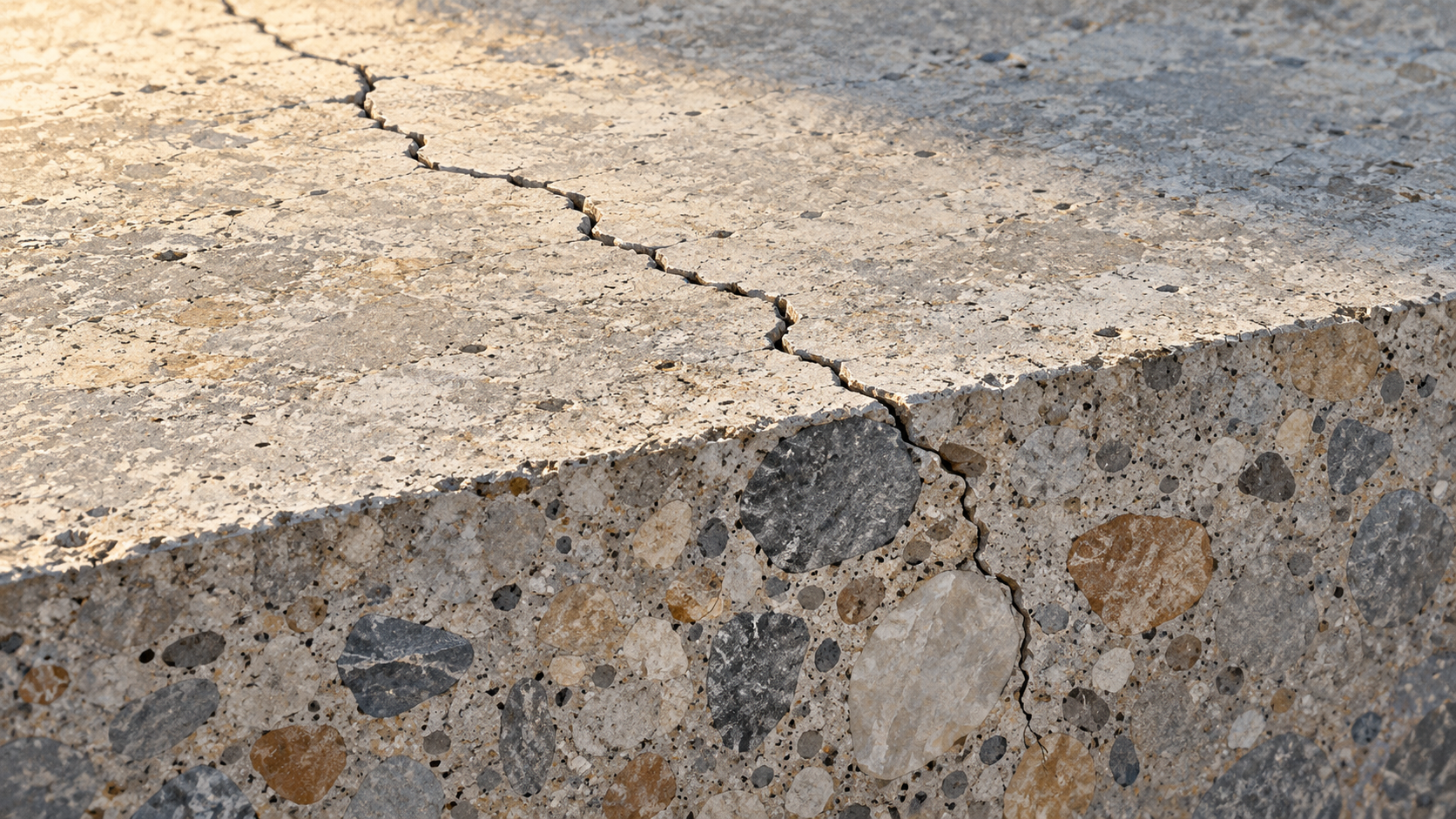
Drying lumber can produce a more damaging version of the same unequal timing. The outside dries and begins to shrink while the core is still wetter. The core restrains the shell; later, as the core dries, the pattern of stress can reverse. The Forest Products Laboratory's drying account links these internal stresses to checking and other defects when drying is poorly controlled. A crack at an end is not simply wood “wanting to move.” It is wood whose parts have been forced to move at different times while remaining joined.
Working with the change
Drying wood before use brings it closer to the conditions expected in service. Storing and installing it under those conditions reduces the surprise after fitting. Design then gives the remaining movement somewhere to go: the Laboratory advises that wide solid panels be free to move across the grain, and that flooring have room at its edges for expansion. The aim is a sound fit over a range of normal humidity, rather than a perfect fit on only one day.
A finish changes the rate, too. R. Sam Williams's Forest Products Laboratory chapter on finishing distinguishes a coating's resistance to water vapor from its ability to repel liquid rain. A film can slow vapor entering wood and slow it leaving again; it does not make wood permanently moisture-proof or alter the equilibrium the wood will eventually approach. A water repellent may be valuable against brief liquid wetting while doing little to slow vapor exchange. “Sealed” is therefore a poor substitute for asking what kind of water a finish resists, for how long, and on which faces it is applied.
The hidden moisture is not a defect to remove once and for all. It is part of the board's working relationship with the room. The width at an edge records the air the wood has met; a bend can show that one face has answered sooner than the other. When a joint leaves that movement a little space, the board's changes can remain ordinary instead of becoming damage.
A thought worth keeping?