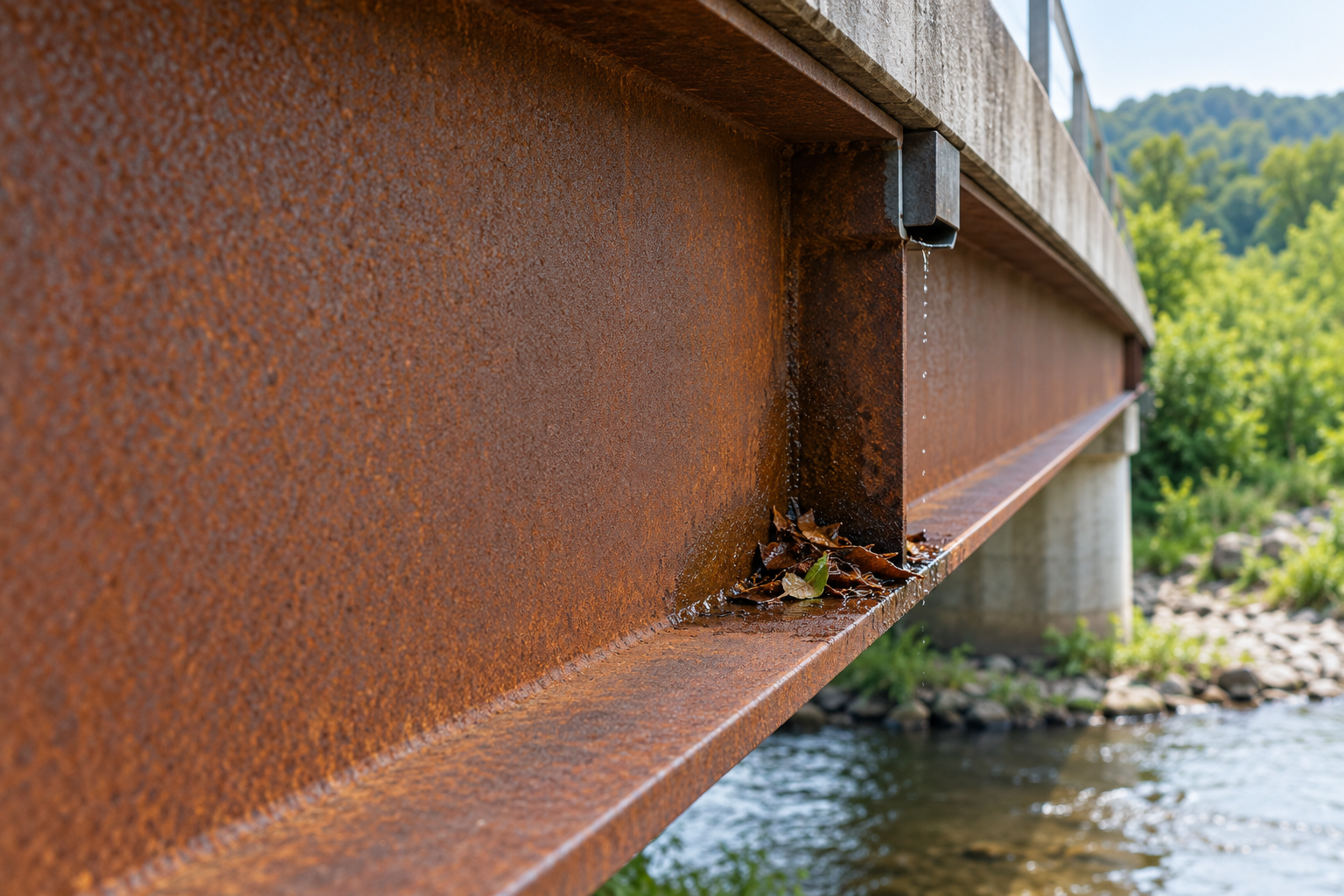
The brown surface of a weathering-steel bridge is meant to be there. Left unpainted in a suitable place, the steel develops a close-fitting rust layer that slows further attack. That visible finish is why a passing observer may think the bridge has already done its weathering. Yet two parts of the same girder can live in different climates: one takes rain and dries, while another sits beneath a leaking joint with wet leaves and road salt pressed against it.
Weathering steel contains small additions of alloying elements that change how its surface corrodes. The Steel Construction Institute's design guide describes copper, chromium, nickel and phosphorus among the elements used in these grades. The result is not metal that refuses to rust. In favourable conditions, an adherent patina develops and the corrosion rate slows. The Irish highway-structure standard makes the condition explicit: the protective layer depends on repeated wetting and drying. The standard still requires a corrosion allowance in design, accounting for steel lost as that surface forms and as the bridge ages.
The word weathering can make the mechanism sound automatic. It is more local than that. Moisture must leave the surface often enough for a protective layer to develop. Chloride from sea spray or de-icing salt can interfere; water trapped in a crevice can keep the steel damp. The steel may be unpainted over most of a bridge and need protection at a vulnerable joint. The same standard permits local treatment where the exposure is unsuitable for bare weathering steel.
Rain on one face, salt under another
A Federal Highway Administration corrosion study offers a revealing comparison. Researchers exposed weathering-steel coupons beneath Moore Drive Bridge in Rochester, New York, where road salt reached the underside. Over four years, the coupons lost about 10 thousandths of an inch, or 0.254 millimetres, of thickness. The report compared that result with exposed coupons at Kure Beach, North Carolina. Although the two sites received broadly similar chloride deposits in the comparison, the Rochester coupons lost metal about five times faster. Rain periodically washed the open-air coastal coupons; salt built up on the sheltered bridge coupons and flanges.
That comparison cannot assign one corrosion rate to every bridge near salt. It shows why even a regional climate map may miss the environment of a bottom flange. The FHWA study found that the protective rust chemistry did not form on the Rochester coupons under the high salt deposition. A steel surface beneath a deck can be both sheltered from cleansing rain and exposed to contaminated spray from traffic below. The exact path of water matters more than the brown colour seen from a distance.
The drainage details are therefore part of the material choice. The FHWA's technical advisory on unpainted weathering steel urges designers to keep deck runoff away from structural steel, control water at joints, avoid pockets that retain debris and protect steel close to expansion joints. A joint cannot simply be called watertight and forgotten; the advisory says its leakage should be anticipated and diverted. The Irish standard likewise calls out bottom flanges, where water and debris collect along horizontal surfaces, and requires that all parts be able to dry.
This is practical design rather than a cosmetic preference. A drain that sends salt water onto a leg, a small hole blocked by leaves, or an overlapping plate that holds moisture can defeat the exposure pattern the alloy needs. Paint in a local risk area is compatible with using bare steel elsewhere. Neither a coating nor the alloy replaces a maintenance plan for keeping water moving away from load-carrying members.
Read the surface, then measure the steel
Inspectors can learn from the patina without treating colour as a complete diagnosis. The Irish standard's inspection guidance distinguishes a fine, adherent granular layer from coarse, swelling laminations and flakes. The latter warrant investigation. It directs inspectors to check for flaking and swelling, investigate leakage, remove dirt and debris, and measure the remaining steel thickness at identified locations. Rust thickness is not the same as load-bearing metal thickness.
A Federal Highway Administration bridge-performance project found that 96% of responding bridge owners had a positive view of unpainted weathering steel, while 40% of that positive group still reported drawbacks in particular settings. This was an owner survey during an ongoing research program, not a census of how many bridges are safe. Its useful distinction is between good overall experience and the wet, salty places that need closer attention.
The consequences of ignoring those places are documented in the National Transportation Safety Board's investigation of Pittsburgh's Fern Hollow Bridge. The bridge collapsed in January 2022 after severe corrosion and section loss at a fracture-critical transverse tie plate on its southwest leg. Clogged drains let water run down the legs; water and debris accumulated near their bases and prevented a protective patina from developing. Inspection reports had repeatedly recommended maintenance and repair. The NTSB also found failures in follow-up, inspection methods and load rating.
The agency expressly concluded that choosing uncoated weathering steel was not itself a cause of the collapse. Suitable material had been put into an exposure and maintenance history that left critical steel unprotected and thinning. The distinction matters. A dramatic failure does not make every rust-brown bridge suspect, just as an attractive patina cannot certify the thickness of a hidden plate.
Weathering steel works by slowing corrosion under conditions that designers can shape and inspectors can keep checking. A good surface is made partly by alloy chemistry and partly by the ordinary route of rain: where it lands, where it drains, what it carries and whether the steel can dry afterward. The engineering is visible in the steel, but also in the gutters, joints and clear space beneath it.
A thought worth keeping?